
Why is it important to have my teeth X-rayed?
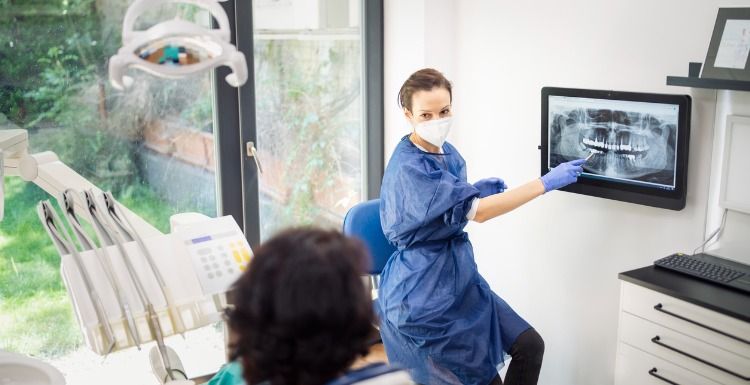
Dentists are looking for any changes and potential problems which may need treatment when examining your teeth. Regular appointments help to diagnose issues before they become more serious. However, there’s a limit to how much can be seen with the naked eye, no matter how thorough the dental examination. This is why x-rays are so valuable, because they help to see between and inside the teeth where tooth decay (holes) is hidden and commonly occurs.
An x-ray can help to pick up signs of decay underneath even when the enamel on the tooth surface may appear intact. X-rays also help to detect problems with the roots of the teeth, changes in the bone, unerupted teeth such as wisdom teeth, infections and if there are issues with the jaw and facial bones. X-rays also assist with planning for dental care, including fillings, implants, tooth extraction and orthodontics.
Definitely. Modern digital x-rays are safe for adults and children as they use very small amounts of radiation to create an image of the teeth and bones of the mouth.
Radiation is measured in units called ‘Micro-Sieverts’. Walking around each day exposes us to natural background radiation of 10 micro-sieverts whilst eating a banana is equivalent to 0.1 micro-sieverts. To put this into perspective, a typical single dental x-rays is equivalent to the natural radiation of eating two bananas.
If you are pregnant or breastfeeding, let your dentist know before you have any dental examination, including x-rays. According to health experts, for women who have not had a recent dental check and where there are benefits in having an x-ray, there is no need to defer having one. [1]
When we look at x-rays, we are looking for subtle changes in how light or dark an area on the x-ray appears to the surrounding area. This tells us if there has been any change in the mineral structure of the teeth and bone.
The type of x-ray you have will be based on the information your dentist needs.
- The most common type is what’s known as ‘Bite wing’ x-rays, which are generally taken at your first visit and then at intervals of between 12-24 months depending on your tooth decay risk factors.
- Periapical x-rays help to view the entire tooth, including the roots and surrounding bone. These types of x-rays are useful for helping to diagnose infections, bone levels, toothaches or root structures and are required before a tooth is extracted.
- Panoramic x-rays, also called a ‘full mouth x-ray’ or OPG, help to visualise the entire mouth, sinuses, bones and jaw and to assess the stages of tooth development in children. They’re also useful to view the wisdom teeth and determine the extent of gum disease. These type of x-rays are typically taken at an initial consultation and every 5 years thereafter.
- A lateral cephalometric x-ray which is taken side on, is often done in combination with a full mouth x-ray, and helps to plan orthodontic treatment.
- A CBCT or 3D x-rays is taken when we need to accurately visualize the structures of the mouth in 3D, for implant planning, orthodontics, or following trauma
Your dentist will advise you about the type and frequency of x-rays required. We aim to minimise the number of x-rays we take. Typically, your dentist will take a set of baseline x-rays such as bitewings, periapicals and OPG’s on your initial visit.
Additional x-rays such as periapicals may be required if you have a toothache, require an extraction or tooth you are having treatment on a tooth such as a crown or root canal treatment.
Contact your local HBF Dental team


All dental procedures carry risks and require aftercare and recovery. Any decision to undertake a dental procedure should be discussed with your treating practitioner taking into account your individual circumstances. In particular, you should discuss with your practitioner common risks, aftercare and recovery. Images on this website are provided as examples only and may not be of actual patients. Individual results may vary, including due to individual factors including anatomy, and adherence to care plans.